The Key to a Cabin That’s Comfortable (and Profitable) in Any Season

It’s simple. For an investment cabin to make sense, it needs to be profitable.
That means positive cash flow year-round. The trouble is, many campground and short-term rental owners have to close their cabins in the colder months—losing income for a full quarter of the year (and possibly even receiving complaints at the peak of summer).
The good news is you can offer a comfortable rental experience any time of year—inspiring connection, reflection, and lasting memories for your guests. The key is investing in a unit built to handle every season with ease.
With that in mind, this guide explains the amazing product that makes CabinPro cabins so comfortable—and profitable—year-round. Give it a quick read to learn what it is, how it works, why we wouldn’t use anything else in our cabins, and why you shouldn’t pay for a prefab cabin without it.
What Leads to Uncomfortable Temperatures in a Building?
To understand why cabins get so cold during the winter (and hot in the summer), it’s helpful to understand energy loss in a building.
When it comes to poor thermal insulation, there are three main culprits:
- Air Infiltration: Air coming in from the outside through gaps, cracks, and tiny leaks in a building’s exterior amounts to 40–50% of total energy loss.
- Thermal Bridging: Wood and metal studs conduct heat more rapidly than insulating materials—meaning heat is lost (or brought in) through the studs between insulation.
- Windows & Doors: Single-pane glass, warped frames, and degraded weatherstripping are major sources of conduction and convection loss.
In other words, maintaining a comfortable internal cabin temperature comes down to energy efficiency—how well insulated the unit is.
There are multiple ways a building can be insulated, but at CabinPro, we choose one and only one: closed-cell spray polyurethane foam.
Here’s what that is.
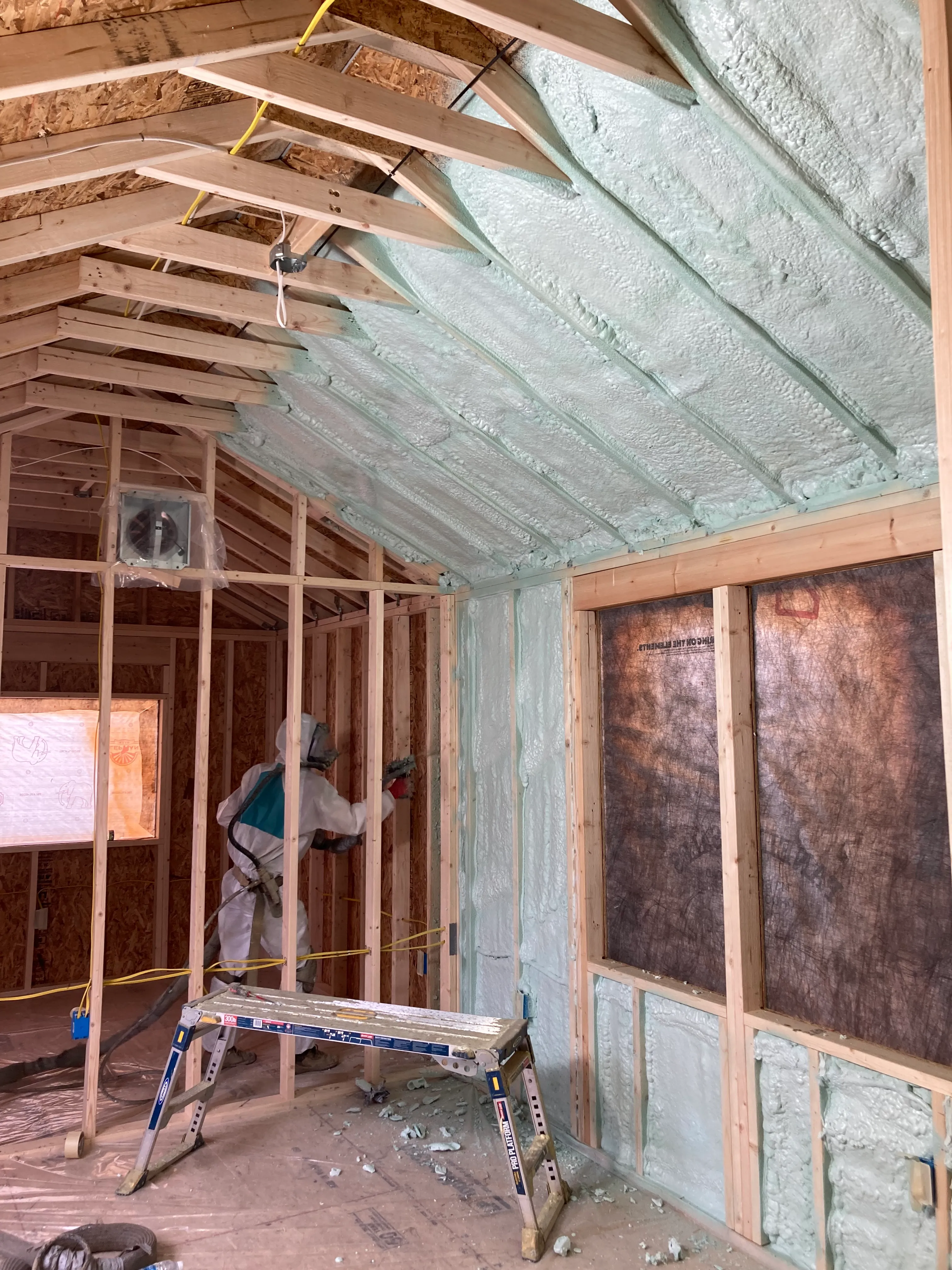
What is Closed-Cell Spray Polyurethane Foam?
Closed-cell spray polyurethane foam is a high-density, rigid insulation material applied as a fluid foam. As the foam is applied, it expands and hardens into a dense, rigid plastic filled with tiny sealed bubbles (cells). These bubbles (cells) are closed and contain an inert insulating gas.
Insulating cabin walls and ceilings with closed-cell spray foam has several advantages:
- The expanding foam bonds to surfaces and cures into a dense, airtight wall providing nearly double the thermal resistance of fiberglass. (In fact, 3” of closed-cell spray foam will outperform R60 fiberglass insulation—the highest recommended R-value—that’s 17–22” thick!)
- By creating a continuous wall of insulation with no air gaps between fiberglass batts and wall studs, thermal bridging is reduced by over 90% with just 2” of insulation—reducing your overall HVAC load (and bills) by 30–50%.
- Insulating bubbles are completely enclosed and packed together, creating a waterproof vapor barrier that prevents condensation, mildew, mold, and rot. Closed-cell spray foam is so effective against water leakage that it’s used in the bottoms of ships to prevent a ship from sinking in the event of hull damage.
- Unlike blown-in fiberglass or batts, closed-cell spray foam’s hardened, cured structure does not sag, settle, or degrade—maintaining its energy efficiency for 50+ years.
- Once cured, closed-cell spray foam’s rigid, high-density structure adds architectural strength to your cabin, preventing racking (rectangular framing leaning to one side or the other) over decades of use—especially important when transporting a prefab cabin by truck.
Simply put, closed-cell spray foam insulation is the best product on the market.
Which begs the question…
Why Don’t All Prefab Log Cabin Homes Use Closed-Cell Spray Foam Insulation?
There are two reasons many prefab cabin manufacturers don’t use closed-cell spray foam as their default product:
- Closed-cell spray foam costs $1.50–$5.00+ per sq. ft. This is up to 5x more than fiberglass, which costs $.50–$1.50 per sq. ft.
- Closed-cell spray foam requires specialized equipment and experienced installation, most often requiring subcontractors.
Despite these initial barriers, the added costs and complexities are well worth it.
Here’s why we encourage all of our investors to purchase a cabin with closed-cell spray foam installation:
- Closed-cell spray foam’s significantly higher R-value reduces utility bills in both summer and winter (50% HVAC reduction across the board).
- With closed-cell spray foam insulation and standard minisplits, guests are kept comfortable to temperatures as low as -5°F. This translates to year-round rental income.
All in, investing upfront for a four-season cabin is the smart move financially. And when you consider lost rental revenue, higher utility bills, and negative guest experiences, prefab cabins without closed-cell spray foam insulation simply aren’t worth it.
Find the Perfect Rental Cabin for You and Your Guests Today!
Ready to offer your guests an amazing experience?
Go ahead and explore our more popular models today. All are energy-efficient, comfortable in nearly any climate, and designed for year-round rental income.
So why wait on setting up your successful rental?